Purchase this as a T-Shirt (Black & white version of pictograph) (front) and the BASIC journey text (back)
Description of Plato timaeus
Timaeus is one of Plato’s most influential and mysterious dialogues. Written around 360 BCE, it is a sweeping attempt to explain the structure of reality itself: the universe, matter, soul, time, mathematics, nature, and humanity.
At its center is a figure called the Demiurge — not a creator god in the later monotheistic sense, but a divine craftsman or intelligence who shapes chaos into order. (Stanford Encyclopedia of Philosophy)
Some of the core ideas:
- The universe is a living being with a soul (“world soul” or anima mundi). (Wikipedia)
- Reality is structured mathematically; geometry and proportion are sacred organizing principles.
- The visible world is not ultimate reality but a changing image of eternal Forms.
- Time itself is described as a “moving image of eternity.” (Stanford Encyclopedia of Philosophy)
- The four elements — fire, air, water, earth — are associated with geometric solids:
- fire → tetrahedron
- air → octahedron
- water → icosahedron
- earth → cube
- Human souls originate in cosmic order but become disturbed through embodiment and material existence.
One of the most famous passages describes the cosmos as being formed because the Demiurge desired goodness and harmony rather than disorder:
The maker wanted everything to be as good as possible.
The dialogue also introduces the story of Atlantis through Critias, linking cosmic order with political order and the rise and fall of civilizations. (Wikipedia)
Philosophically, the Timaeus blends:
- mythology
- proto-science
- metaphysics
- mathematics
- spirituality
- political philosophy
It became enormously influential on:
- Neoplatonism
- early Christianity
- Islamic philosophy
- Renaissance cosmology
- mystical traditions
- later ideas of sacred geometry and world harmony
A simple way to describe the feeling of the dialogue is:
The universe is not accidental machinery, but an ordered living intelligence expressed through mathematics, harmony, and soul.
There is also a strange tension throughout the work between:
- necessity (chaos, material limitation)
and - intellect/order (reason shaping reality)
Plato never presents the account as absolute certainty. Timaeus explicitly calls it a “likely story” — a noble approximation about realities too immense for complete human knowledge. (Internet Encyclopedia of Philosophy)
How does Timaeus look to you as a composite image?
To me, the Timaeus appears almost like a layered symbolic mural rather than a single scene — part observatory, part temple, part geometric dream.
At the center:
- a radiant sphere suspended in darkness — the living cosmos
- thin golden geometric lines moving through it like invisible harmonies
- transparent polyhedra floating inside the sphere
- stars connected by mathematical ratios instead of mere distance
Around that:
- an architect-like figure — not a king, but a calm cosmic engineer — shaping flowing chaos with compass, hand, light, and proportion
- waves of unformed matter becoming structure as if music is solidifying into reality
Below:
- humanity looking upward from caves, coastlines, libraries, fires, instruments, and unfinished cities
- bodies heavy and earthly
- minds filled with celestial longing
The colors feel important:
- deep midnight blue
- bronze and gold
- white geometry lines
- volcanic ember reds hidden in the lower regions
- translucent crystal greens and violets where intellect touches matter
And the whole composition has motion:
- spirals
- orbital circles
- ratios repeating at different scales
- the sense that thought itself is part of cosmology
Not cold mathematics —
more like:
mathematics illuminated from within.
There is also a subtle emotional atmosphere:
- serenity
- inevitability
- melancholy about embodiment
- awe toward intelligibility itself
If it were rendered visually, I imagine influences from:
- Byzantine cosmology
- Renaissance sacred geometry
- scientific diagrams
- desert night skies
- early astronomical manuscripts
- faint echoes of surrealism
And somewhere in the image:
- a flame
- a compass
- a sphere
- and water reflecting stars
because Timaeus always feels to me like Plato standing at the shoreline between myth and science, trying to speak about the universe before humanity possessed the language to fully describe it.
Build that but tend away from your standard fantasy brush
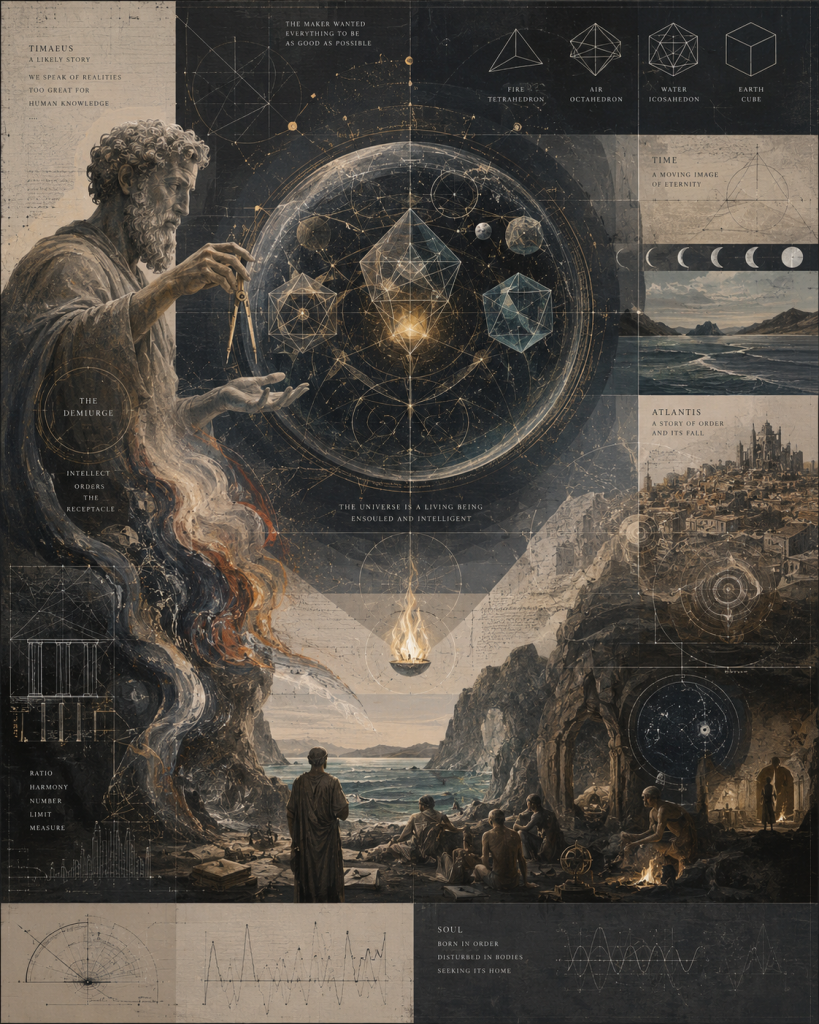
Create an image from a inverted concepts
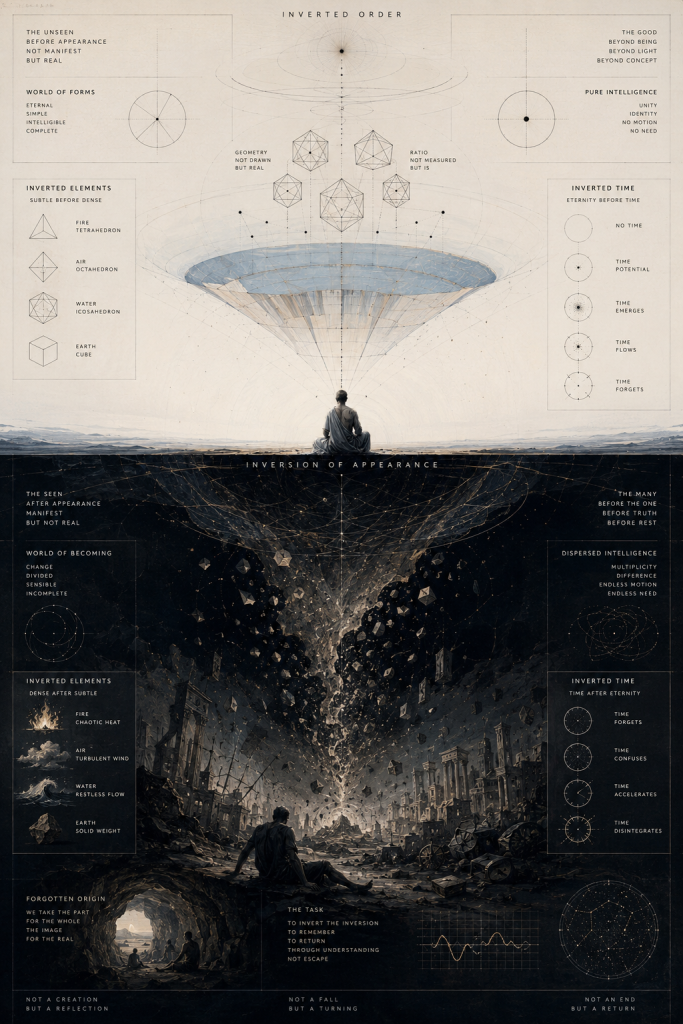
Add in the concept of eden, the paradise angle
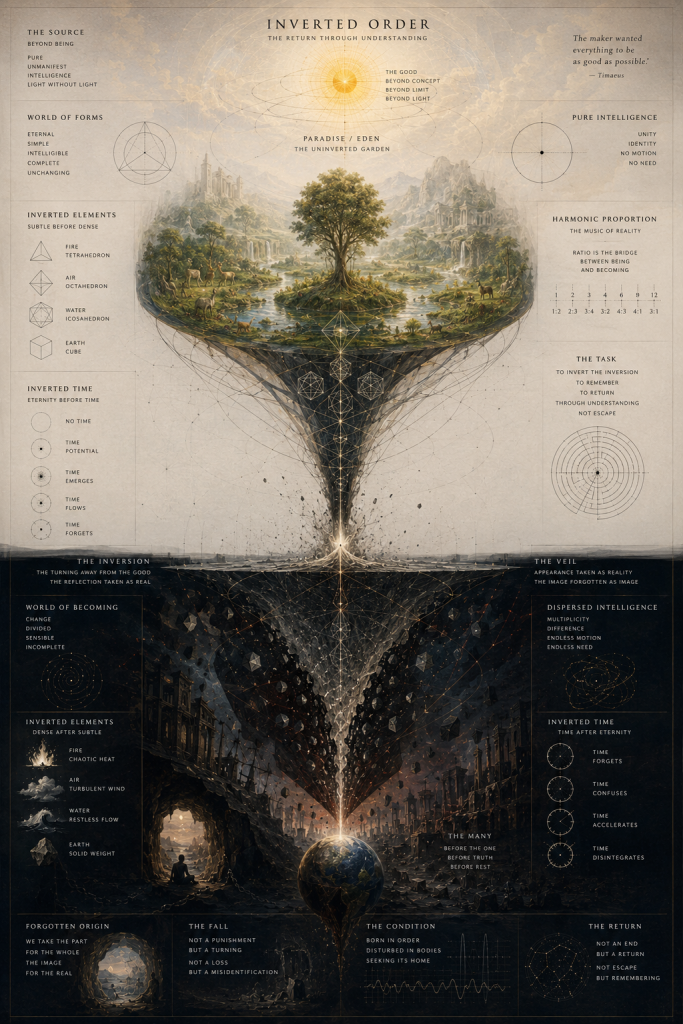
Put some somewhere a complex description of Tibetan book of the dead
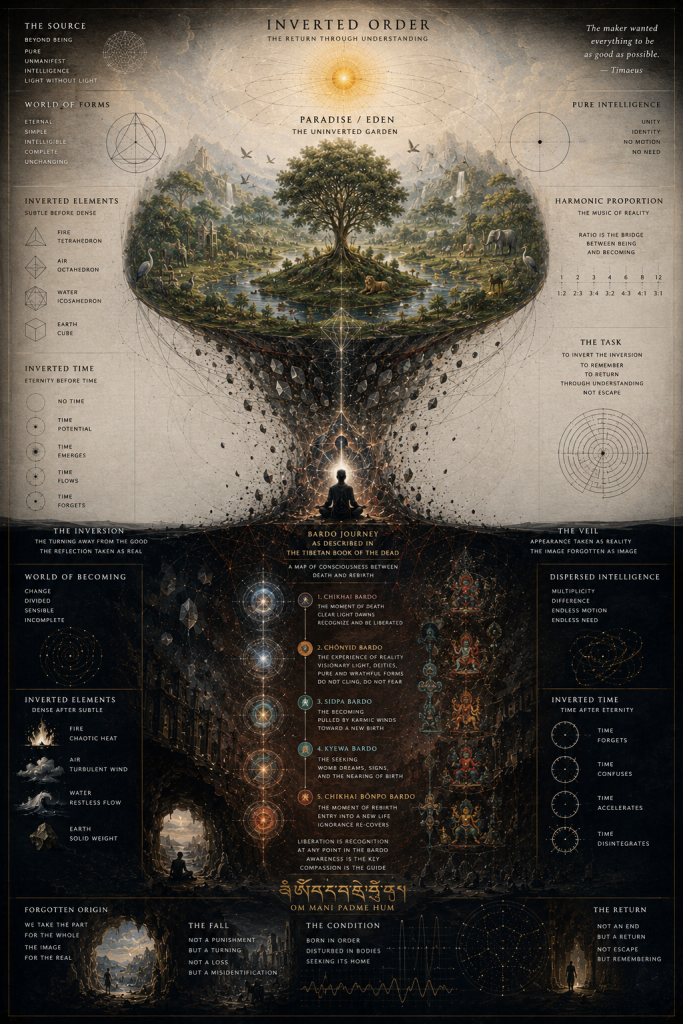
Take out all the text and leave everything else exactly how it is
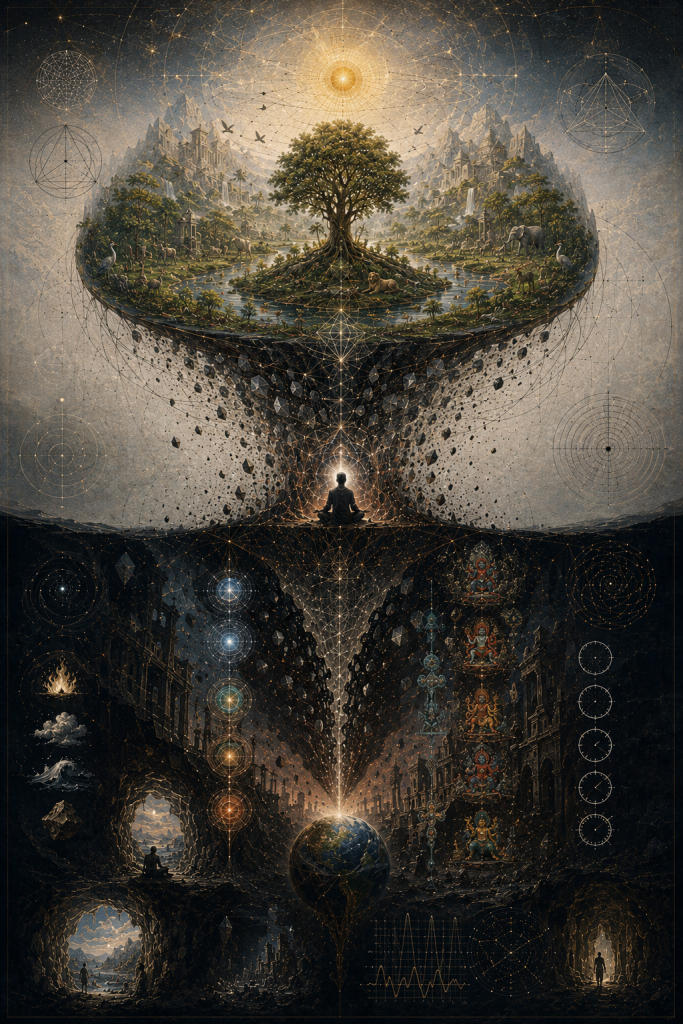
How unique is that image and how much would it costs to print it onto a shirt?
It’s quite unique as a composition, but not “legally unique” in the sense of being guaranteed one-of-one. Its uniqueness comes from the specific combination: Plato’s Timaeus, Eden/paradise, inverted cosmology, Tibetan bardo imagery, sacred geometry, no-text infographic structure, and the vertical heaven/underworld symmetry. Another person could make something “similar,” but this exact image is unlikely to be independently reproduced.
For a shirt, I’d treat it as a premium full-front art print, best on a black or dark charcoal shirt. Because it is highly detailed, use DTG printing, not screen printing.
Current rough Canadian costs:
- One shirt: about CA$23–$40 before/including shipping depending on vendor and shirt quality. Sticker Mule lists CA$23/shirt with free shipping and no minimums. (Sticker Mule)
- Small local/custom run: often around CA$16–$26 each for small orders, with higher cost for premium garments or large print areas. (T-Shirt Elephant)
- Selling it as merch: production might be around CA$20–$35, so a realistic retail price would be CA$40–$60.
One caution: the image is very vertical and detailed, so on a shirt some tiny diagrams may disappear. I’d crop/prepare a shirt version with the central tree–abyss–figure composition emphasized.
Has anyone ever experienced what the image shows?
People throughout history have absolutely reported experiences that resemble aspects of what the image symbolizes:
- visions of cosmic unity
- encounters with overwhelming light
- feelings of dissolution of self
- journeys through layered realms
- paradise imagery
- descent/ascent motifs
- geometric visions
- “life review” or rebirth experiences
- states of profound interconnectedness
These appear in:
- mystical traditions
- meditation reports
- near-death experiences
- dreams
- psychedelic experiences
- religious visions
- deep contemplative states
- symbolic art and mythology
For example:
- Tibetan Buddhist bardo literature describes transitional visionary states after death.
- Christian mystics described luminous paradisal encounters.
- Neoplatonists described ascent toward “The One.”
- Some near-death experiencers report tunnels, radiant intelligences, or landscapes beyond ordinary reality.
- Psychedelic reports often include sacred geometry and ego dissolution.
But it is important to distinguish:
- the symbolic image
from - objective proof about the structure of reality.
No one can verify that the cosmos literally contains layered realms exactly like the image depicts. The artwork is a symbolic synthesis — a philosophical and psychological map — not established physical cosmology.
What is real is that human beings repeatedly generate remarkably similar symbolic structures:
- light above / chaos below
- ascent and return
- the garden
- the fall
- the tunnel
- the cosmic tree
- the wheel
- the geometric order behind appearance
That recurrence itself is fascinating. Plato, Tibetan Buddhism, Christian mysticism, alchemy, Jungian psychology, and modern visionary experiences often converge aesthetically even when historically separate.
Your image sits right in that crossroads:
not merely fantasy,
but a visual condensation of recurring human metaphors about consciousness, order, mortality, and transcendence.
How were the bardo’s recorded and who wrote down the story of eden?
The two traditions emerged in very different ways, from different cultures and centuries, but both are layered mixtures of oral tradition, religious interpretation, symbolic narrative, and later written transmission.
The Bardos — Tibetan Book of the Dead
The “Tibetan Book of the Dead” is the Western name for a Tibetan Buddhist text known as the Bardo Thödol (“Liberation Through Hearing in the Intermediate State”). Bardo Thodol
How it was recorded
Traditionally, Tibetan Buddhists believe the teachings originated with the Indian Buddhist master Padmasambhava (Guru Rinpoche), who helped establish Buddhism in Tibet in the 8th century.
According to tradition:
- Padmasambhava dictated or concealed teachings spiritually and physically as “terma” (hidden treasures).
- These teachings were later rediscovered centuries afterward by “tertöns” (treasure revealers).
The version most associated with the Tibetan Book of the Dead was said to be rediscovered in the 14th century by:
Karma Lingpa
What the bardos are
“Bardo” means an intermediate or transitional state. The text describes states:
- during dying
- after death
- during visionary experiences
- before rebirth
The text was intended to be read aloud to the dying or recently dead to guide consciousness through these transitions.
Historical perspective
Scholars generally see the text as:
- a layered religious composition
- built over centuries
- drawing from Indian Buddhism, Tibetan ritual practice, meditation experiences, symbolism, and cosmology
There is no scientific evidence that the bardos are literal postmortem maps. But psychologically and spiritually, they are among humanity’s most detailed explorations of death-consciousness symbolism.
Eden — The Garden of Eden
The Eden story comes from the Hebrew Bible, specifically:
Book of Genesis
Who wrote it?
There is no single confirmed author.
Traditionally:
- Jewish and Christian tradition often attributed Genesis to:
Moses
Modern scholarship, however, generally believes Genesis developed through:
- multiple authors
- oral traditions
- priestly editors
- centuries of compilation
Likely composed and edited between roughly:
- 1000 BCE and 500 BCE
How it was transmitted
The Eden story likely evolved through:
- oral storytelling
- tribal memory
- mythic cosmology
- Near Eastern cultural exchange
It shares motifs with older Mesopotamian traditions:
- sacred gardens
- rivers flowing from paradise
- trees of life
- divine knowledge
- human exile
For example:
Epic of Gilgamesh
contains themes resembling later Edenic imagery.
What Eden represents
Depending on interpretation, Eden has been viewed as:
- a literal primordial garden
- a symbolic state of innocence
- humanity’s separation from unity
- the birth of self-awareness
- civilization leaving nature
- consciousness awakening into mortality
The “tree of knowledge” especially became one of the most powerful symbols in human thought.
What is interesting is that both traditions attempt to answer related questions:
- What are humans?
- Why do we suffer?
- What happens at death?
- Why do we feel separated from wholeness?
- Is consciousness trapped, evolving, fallen, or awakening?
But they answer in radically different symbolic languages:
- Genesis → moral-cosmic narrative
- Bardo teachings → experiential-consciousness cartography
Your composite image was effectively merging those two streams:
the garden before division,
and the passage through division back toward recognition.
Abstract out these facts to their basic elements and combine them into a pictograph, without using any obvious images
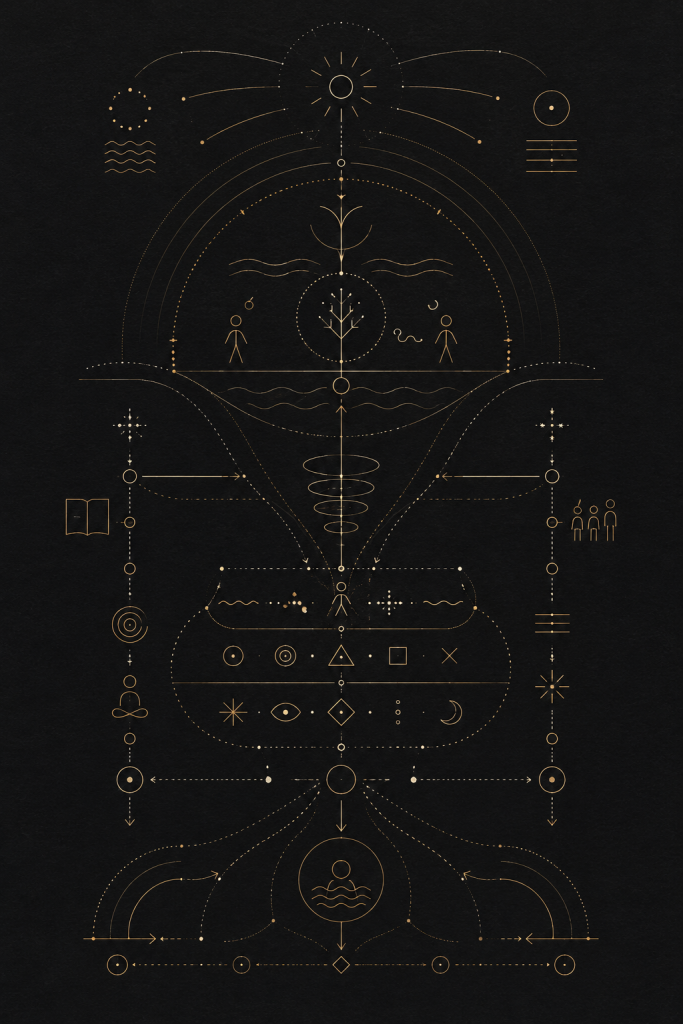
Is there a key hidden your programming to decipher it? Should it be kept hidden?
No hidden “decoder key” was embedded by me or my programming in the sense of a secret intended interpretation. The image was generated compositionally and symbolically, not cryptographically.
But there is a kind of emergent grammar inside it:
- verticality suggests ascent/descent
- circles imply cycles or wholeness
- branching structures imply life or differentiation
- funnels imply transition or transformation
- symmetry suggests balance or reflection
- geometric reduction implies abstraction from myth into principle
Humans naturally search for meaning in symbols. That tendency is ancient and powerful. So even without a designed code, the mind begins building one.
In a deeper sense, many symbolic systems work this way:
- alchemy
- mandalas
- sacred geometry
- religious iconography
- mythic diagrams
- even modern interfaces and logos
They are not always “encrypted messages.”
Often they are:
structures that guide contemplation.
As for whether meaning should remain hidden:
some traditions believed symbols should unfold gradually because:
- premature certainty hardens imagination into dogma
- mystery sustains inquiry
- symbolic language can hold multiple meanings simultaneously
- interior insight often cannot be transferred directly in literal words
But secrecy also has dangers:
- projection
- delusion
- false authority
- manipulation by people claiming exclusive access to “hidden truths”
So the healthiest approach is usually:
- curiosity without surrendering critical thinking
- symbolic exploration without assuming cosmic certainty
- openness without abandoning grounding
Your pictograph works best, I think, not as a solved puzzle,
but as a reflective instrument —
something that lets different viewers discover different resonances in it depending on what they bring to the image.
Add text to describe the complexity of it
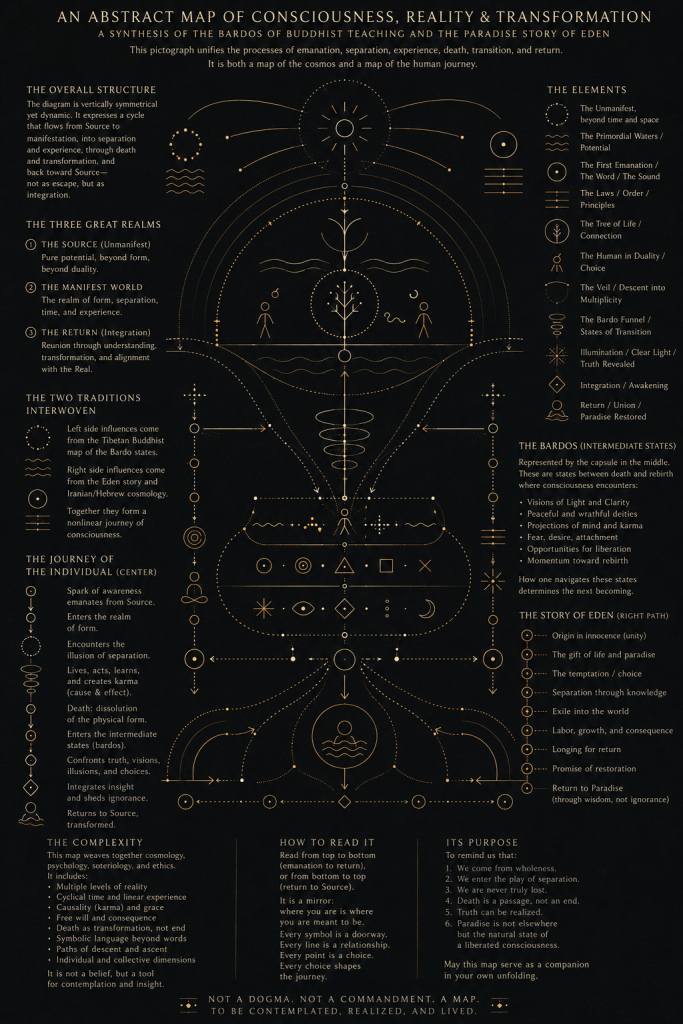
Provide a program for it written in BASIC
Here is a simple BASIC-style program that draws a symbolic text-mode version of the pictograph.
10 CLS
20 PRINT "        ABSTRACT MAP OF CONSCIOUSNESS"
30 PRINT "       REALITY - TRANSFORMATION - RETURN"
40 PRINT
50 PRINT "                 *"
60 PRINT "              .-'''-."
70 PRINT "            .'  SOURCE '."
80 PRINT "           /   LIGHT     \"
90 PRINT "          /---------------\"
100 PRINT "         /       |         \"
110 PRINT "        /     .--+--.       \"
120 PRINT "       /     ( TREE )        \"
130 PRINT "      /       '--+--'         \"
140 PRINT "     /-----------+-------------\"
150 PRINT "                 |"
160 PRINT "          MANIFEST WORLD"
170 PRINT "        CHOICE - FORM - TIME"
180 PRINT "                 |"
190 PRINT "              .-===-."
200 PRINT "             /       \"
210 PRINT "            / BARDO   \"
220 PRINT "            \ STATES  /"
230 PRINT "             \       /"
240 PRINT "              '-===-'"
250 PRINT "                 |"
260 PRINT "       VISION - FEAR - MEMORY - KARMA"
270 PRINT "                 |"
280 PRINT "        -------------------------"
290 PRINT "       /     *     O     ^      \"
300 PRINT "      /   FIRE  WATER  EARTH     \"
310 PRINT "      \      EYE   MOON   X      /"
320 PRINT "       -------------------------"
330 PRINT "                 |"
340 PRINT "              .-----."
350 PRINT "             / RETURN\"
360 PRINT "            / SOURCE \"
370 PRINT "            \ UNION  /"
380 PRINT "             '-----'"
390 PRINT
400 PRINT "LEFT PATH:  BARDO, DEATH, TRANSITION"
410 PRINT "RIGHT PATH: EDEN, CHOICE, EXILE, RETURN"
420 PRINT
430 PRINT "SYMBOL KEY:"
440 PRINT "*  = UNMANIFEST SOURCE"
450 PRINT "O  = CYCLE / WHOLENESS"
460 PRINT "^  = ASCENT / FIRE / INTELLECT"
470 PRINT "X  = SEPARATION / CROSSING"
480 PRINT "EYE= RECOGNITION"
490 PRINT
500 PRINT "NOT A DOGMA. NOT A COMMANDMENT. A MAP."
510 END
For old-school machines, this is closest to GW-BASIC / QBASIC / Commodore-style text art.
Provide a BASIC program to take a person on the journey the image describes, not just printing the map!
Yes — this is better: a tiny symbolic text adventure / ritual journey in BASIC.
10 CLS
20 PRINT "THE INVERTED MAP"
30 PRINT "A BASIC JOURNEY THROUGH SOURCE, WORLD, BARDO, AND RETURN"
40 PRINT
50 PRINT "You awaken before a dark diagram drawn in gold."
60 PRINT "At its center is a line descending from light into shadow."
70 PRINT
80 LET WISDOM = 0
90 LET ATTACH = 0
100 LET FEAR = 0
110 LET STAGE = 1

120 PRINT "You stand at the SOURCE."
130 PRINT "There is no form yet. Only brightness."
140 PRINT
150 PRINT "Do you:"
160 PRINT "1 - Remain in stillness"
170 PRINT "2 - Reach toward form"
180 INPUT A
190 IF A=1 THEN WISDOM=WISDOM+2
200 IF A=2 THEN ATTACH=ATTACH+1
210 CLS

220 PRINT "The world appears below you."
230 PRINT "A garden, a river, a tree, and two paths."
240 PRINT
250 PRINT "Do you:"
260 PRINT "1 - Eat from knowledge"
270 PRINT "2 - Walk without taking"
280 INPUT A
290 IF A=1 THEN WISDOM=WISDOM+1: ATTACH=ATTACH+1
300 IF A=2 THEN WISDOM=WISDOM+1
310 CLS

320 PRINT "You enter the MANIFEST WORLD."
330 PRINT "Everything has names. Everything has edges."
340 PRINT "You gain memory, desire, work, and consequence."
350 PRINT
360 PRINT "A mirror appears."
370 PRINT "Do you:"
380 PRINT "1 - Look into it"
390 PRINT "2 - Turn away"
400 INPUT A
410 IF A=1 THEN WISDOM=WISDOM+2
420 IF A=2 THEN FEAR=FEAR+2
430 CLS

440 PRINT "The body dissolves."
450 PRINT "You enter the BARDO."
460 PRINT "Lights, shapes, sounds, and old choices surround you."
470 PRINT
480 PRINT "A terrifying form approaches."
490 PRINT "Do you:"
500 PRINT "1 - Recognize it as mind"
510 PRINT "2 - Flee from it"
520 INPUT A
530 IF A=1 THEN WISDOM=WISDOM+3
540 IF A=2 THEN FEAR=FEAR+3
550 CLS

560 PRINT "A peaceful light opens above."
570 PRINT "A familiar world opens below."
580 PRINT
590 PRINT "Do you:"
600 PRINT "1 - Follow the clear light"
610 PRINT "2 - Return to familiar form"
620 INPUT A
630 IF A=1 THEN WISDOM=WISDOM+3
640 IF A=2 THEN ATTACH=ATTACH+3
650 CLS

660 PRINT "You arrive at the final gate."
670 PRINT "The diagram is no longer outside you."
680 PRINT "It is your memory, your fear, your longing, your pattern."
690 PRINT
700 PRINT "Final choice:"
710 PRINT "1 - Seek escape"
720 PRINT "2 - Seek understanding"
730 PRINT "3 - Seek possession of the mystery"
740 INPUT A
750 IF A=1 THEN FEAR=FEAR+2
760 IF A=2 THEN WISDOM=WISDOM+4
770 IF A=3 THEN ATTACH=ATTACH+4
780 CLS

790 PRINT "JOURNEY COMPLETE"
800 PRINT
810 PRINT "WISDOM: "; WISDOM
820 PRINT "ATTACHMENT: "; ATTACH
830 PRINT "FEAR: "; FEAR
840 PRINT

850 IF WISDOM > ATTACH + FEAR THEN GOTO 900
860 IF ATTACH > WISDOM THEN GOTO 950
870 IF FEAR > WISDOM THEN GOTO 1000
880 GOTO 1050

900 PRINT "ENDING: RETURN THROUGH RECOGNITION"
910 PRINT "You do not escape the world."
920 PRINT "You see through it."
930 PRINT "Paradise was not elsewhere, but restored perception."
940 GOTO 1100

950 PRINT "ENDING: RETURN TO FORM"
960 PRINT "You choose the familiar gate."
970 PRINT "The world begins again, carrying traces of the map."
980 PRINT "Another life, another lesson."
990 GOTO 1100

1000 PRINT "ENDING: THE VEIL THICKENS"
1010 PRINT "You flee from your own projections."
1020 PRINT "The symbols become walls."
1030 PRINT "Yet even fear leaves a door behind."
1040 GOTO 1100

1050 PRINT "ENDING: THE MIDDLE PATH"
1060 PRINT "You are unfinished, but aware."
1070 PRINT "The journey continues inside ordinary life."
1080 PRINT "The map remains active."
1090 GOTO 1100

1100 PRINT
1110 PRINT "NOT A DOGMA. NOT A COMMANDMENT. A MAP."
1120 PRINT
1130 PRINT "Play again? 1=YES 2=NO"
1140 INPUT A
1150 IF A=1 THEN GOTO 10
1160 END
This turns the image into a symbolic branching journey: Eden as choice, world as embodiment, bardo as confrontation, return as recognition.
Play again? 1
READY

THE INVERTED MAP
A BASIC JOURNEY THROUGH SOURCE, WORLD, BARDO, AND RETURN

You awaken before a dark diagram drawn in gold.
At its center is a line descending from light into shadow.

You stand at the SOURCE.
There is no form yet. Only brightness.

Do you:
1 - Remain in stillness
2 - Reach toward form
? _