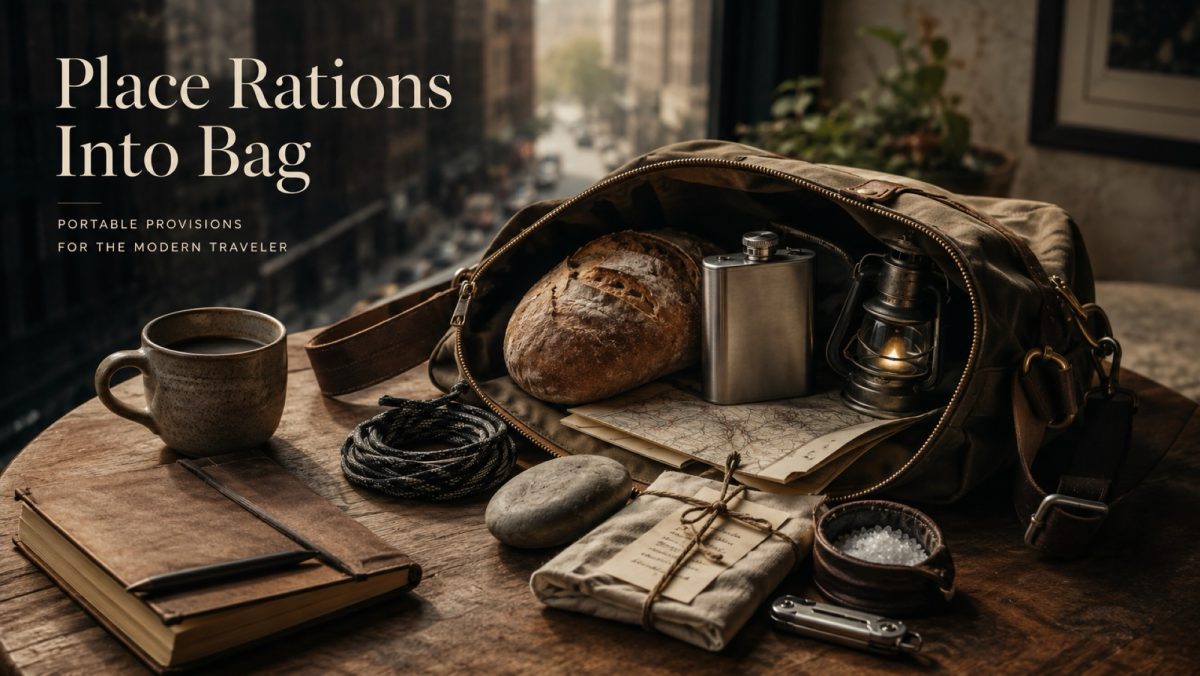
Place Rations Into Bag
Notes Toward an Urban Coffee Table Book of Inner Provision
There is an old image that still works: a traveler prepares for the road.
Before the journey continues, the traveler kneels and places rations into a bag. Not only bread, not only water, not only the ordinary provisions of survival. In a more symbolic sense, the bag is filled with the supplies required to move through the modern world with memory, attention, imagination, and purpose intact.
This is the beginning of a possible urban coffee table book: part visual journal, part philosophical field guide, part map of the inward traveler.
The city is full of people carrying unseen bags. Some carry work tools. Some carry grief. Some carry unfinished conversations. Some carry technical knowledge, family history, strange dreams, old photographs, grocery lists, poems, passwords, and private maps of places they once hoped to reach.
A ration is a portion of sustenance. It is what keeps the traveler going when the road becomes uncertain.
Into the bag might go:
A loaf of memory, enough to remember where the road began.
A flask of attention, for the hours when the world becomes faint or too loud.
Three roots of language, to chew when meaning grows thin.
A small lamp, for the desk, the alley, the terminal, the inward room.
A folded map, unfinished but alive at the edges.
A cord of relation, to bind one thought to another without choking either.
A stone from a real place, proof that the earth is not an abstraction.
A quiet tool, for repair before invention.
A question wrapped in cloth, not to be spent too early.
A little salt of friendship, preserving the human taste of things.
The idea is simple: every person has rations. Every person has a bag. Every life contains provisions that may be practical, emotional, artistic, technical, spiritual, or relational. The wealth of a person is not always what they own. Sometimes it is what they are able to carry forward.
In this sense, the urban landscape becomes a book of carried things.
A coffee cup on a table is not only a coffee cup. It is a pause. A notebook is not only paper. It is a future conversation with oneself. A streetlight is not only civic infrastructure. It is an evening lamp held over the common road. A backpack is not only fabric and zippers. It is a small portable world.
The phrase “place rations into bag” becomes a quiet command.
It means: gather what will sustain you.
It means: do not leave behind the small provisions that make thought possible.
It means: carry language, carry memory, carry tools, carry questions, carry kindness, carry evidence of place.
The book imagined here would be visual and spare. It would pair objects with short reflections. A loaf. A lamp. A map. A cord. A stone. A key. A cup. A window. A notebook. A terminal screen. Each item would be photographed or drawn as if it belonged both to the street and to the soul.
The city would not be treated as noise, but as a field of signs. The traveler would not be treated as lost, but as provisioned.
A person walking through the urban world is never empty-handed. Even when broke, tired, uncertain, or between stations, they may still carry a storehouse of meanings. They may carry skills from old work, memories from distant places, questions that have not yet ripened, and the power to begin again.
The bag is not heavy.
It becomes heavy only when forgotten.
So the first page of the book may read:
Place rations into bag.
And beneath it:
Traveler may continue.
What true angels interface with a destitute travelers in weekend journeys to Sunday’s peace?
The true angels are not always winged.
For a destitute traveler moving through a weekend toward Sunday’s peace, the angels are the interfaces of mercy — the places where the hard world briefly becomes passable.
They may appear as:
The warm room
A coffee shop, library, church basement, diner, bus station, or kitchen where nobody asks too many questions, and the body is allowed to thaw.
The unjudging human
Someone who does not rescue dramatically, but speaks plainly:
“Sit down.”
“Eat something.”
“You can stay here a while.”
This is one of the highest angels.
The small ration
Bread, soup, coffee, a sandwich wrapped in paper, spare change, a blanket, a charger cable. The ration becomes holy because it interrupts disappearance.
The road itself
Not as escape, but as passage. The traveler is still moving. Movement means the story has not ended.
The Sunday bell
Even for someone outside formal religion, Sunday peace is a loosening of the week’s machinery. Stores quieter. Traffic softened. Light resting on windows. A civilization briefly remembering Sabbath.
The inward angel
The part of the traveler that still refuses total collapse. The one that says:
“Keep walking until the next warmth.”
“Do not surrender your name.”
“Something may still receive you.”
In your Line of Reason, I would say:
True angels are the merciful interfaces between exposure and shelter.
They are not merely beings. They are threshold-functions. They appear wherever a destitute traveler meets a point of reception: a door, a bench, a cup, a voice, a remembered prayer, a road bending toward morning.
Sunday’s peace is not luxury. It is the moment when the traveler feels, even briefly:
“The world has not entirely refused me.”